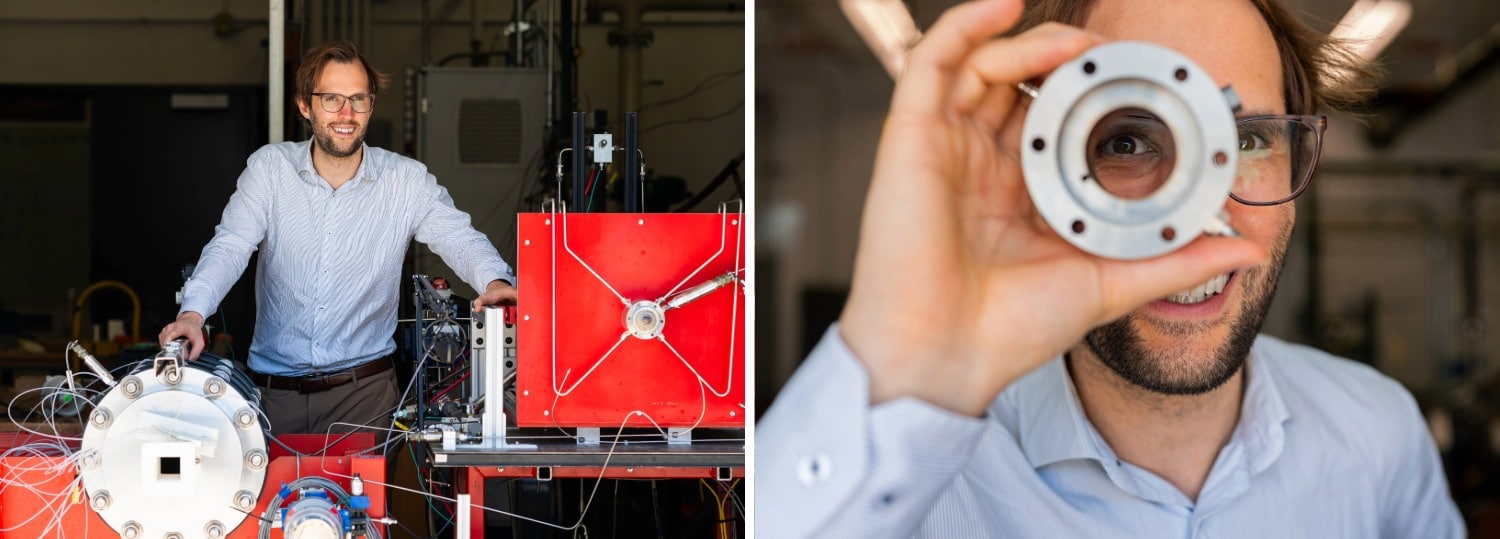
Congratulations to Department of Mechanical and Aerospace Engineering Assistant Professor James Braun on receiving a 2026 Young Investigator Program (YIP) award from the Office of Naval Research (ONR). This highly competitive program supports early-career academics in science, technology, engineering and mathematics.
Braun’s three-year, $750,000 award will support his project, “Characterization and Tuning of the Convective, Conductive, and Radiative Heat Flux in Rotating Detonation Combustors”.
“This award will help me advance my research, but it will also help me support and pay the students working alongside me,” said Braun. “I can fund two graduate students for three years. I can buy materials, equipment and sensors specifically for the combustion cooling – all of the things it takes to run a lab. I can send my students to conferences, so they can show other people our research. Student success is a big part of my mission, and NC State’s mission.”
Braun’s research focuses on novel supersonic propulsion concepts for airbreathing and aerospace applications; essentially, he and the BEFAST team (Braun’s Engineering Factory for Advanced Supersonic Technologies) are working to make aerospace engines faster, more compact and more fuel and energy efficient.
Deflagration
Deflagration engines are the aerospace standard for airplanes. These gas turbine engines use air and fuel that serve as their working fluids. In this type of engine, fuel burns steadily and slowly.
“In any engine, you have fuel and air coming together; they mix, and you ignite that mixture in the combustor to produce power and thrust in the subsequent turbine and nozzle,” said Braun. “Think about a match that you would use to light a candle or something small. It’s the same principle with typical deflagration engines – you use that ‘small’ light to ignite your fuel and oxidizer.”
But Braun’s research, and what he was awarded his YIP funding for, does not focus on improving the traditional deflagration engine. His goal is to refine a different, more compact and fuel-efficient aerospace engine: the rotating detonation engine (RDE).

Detonation
An RDE doesn’t use a ‘match’. It uses an explosion.
“With this engine, we have a more violent way of igniting and combusting that fuel and air mixture – that’s the detonation part,” said Braun. “This way of combusting using detonation is theoretically more efficient and more compact, so you can make engines smaller; this is a phenomenon that has been studied for many decades.”
Detonation is combustion through a supersonic shock. Instead of a steady flame, RDEs utilize a shockwave, traveling at five to eight times the speed of sound (roughly 2,000 meters per second), to burn the fuel.
“You just need to give the engine one initial kick, and then it’s gonna go on forever,” said Braun.
These smaller, lighter and more efficient engines for airplanes and rockets could be a game changer in the aerospace industry. But there’s a catch to RDEs. The powerful force of a detonation creates unsteady conditions that deflagration engines were not designed to handle. These conditions include shock waves that create pressure gradients, high speeds (high subsonic to supersonic) and most importantly, high temperatures and heat loads, which are hard to quantify experimentally. It is a challenge to measure anything in this extreme detonation environment.
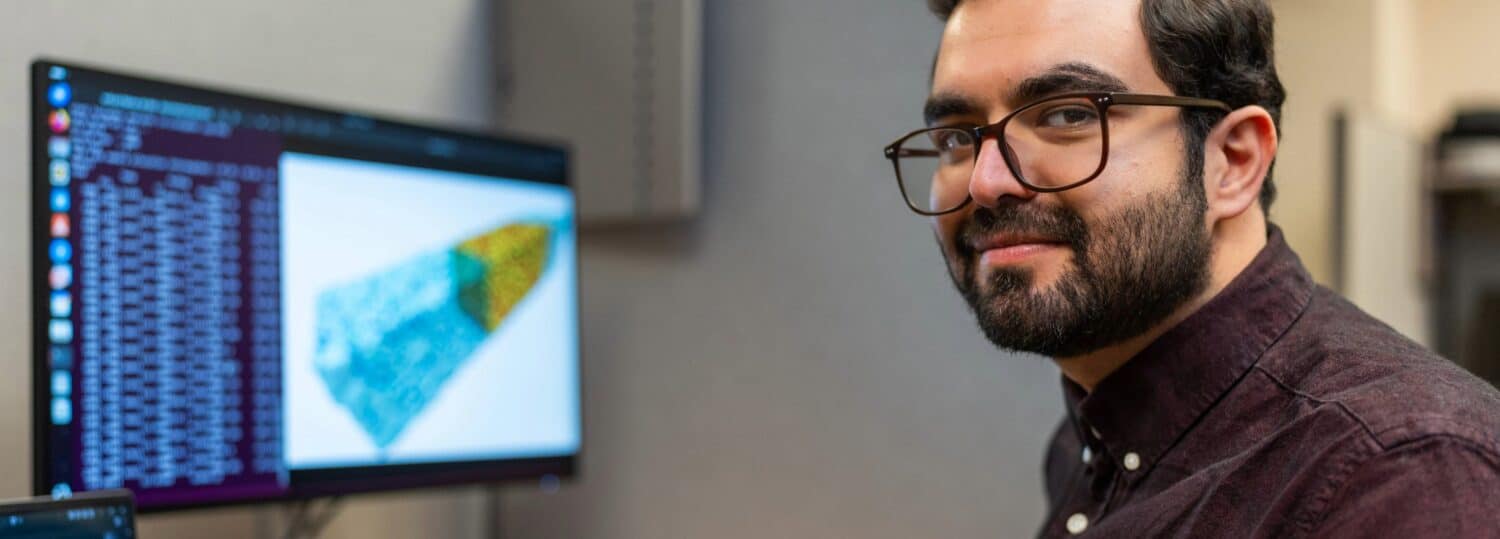
Braun and his team are working to solve these roadblocks using two methods: physical experiments and computational fluid dynamics (CFD) simulations.

Experimenting and Modeling
“Deflagration engines are working and running now,” said Braun, “but how do we make something better? How do we make an engine that’s smaller and more efficient? For the same amount of fuel that we put in, how do we get more out of it? That’s what we are focused on in our lab.”
Braun and the BEFAST team experiment in wind tunnels, examining various types of turbines, and conduct combustion tests on their airbreathing and rocket engine test stand. They also utilize extensive modeling and simulations, saving on both cost and time. This two-pronged approach gives the team the best of both worlds: real-world data from the physical experiments, coupled with the flexibility of modeling.
BEFAST also collaborates with Professor Terrence R. Meyer and Venkat Athmanathan, Ph.D., at Purdue University; using their large-scale RDE tests and optical diagnostics, the NC State team is able to validate and complement computational data.
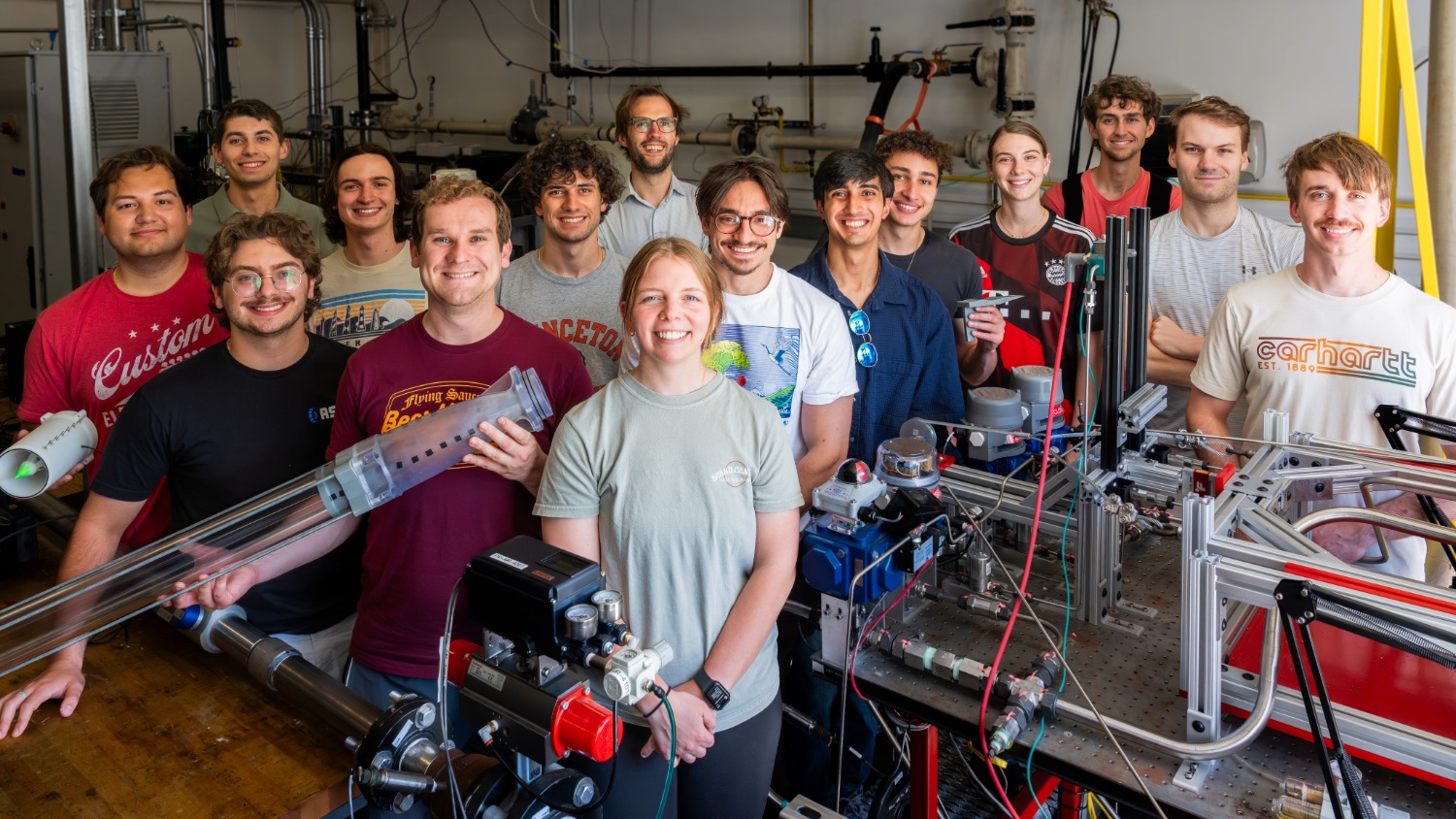
The BEFAST team’s objectives are clear: quantify the heat using simulations, develop new ways to cool and protect the engine, design real-world tests to determine if their heat simulations are correct, and finally, create a reduced-order model (ROM), which is a simplified physics-based program that can accurately estimate heat load. And all of this work is supported by the dozens of undergrads, graduate and Ph.D. students that make up the BEFAST team.
“I really like to collaborate with other people,” said Braun. “I became a professor because I like working with students. It’s a clichè, but it’s true. If they’re successful, I’m successful.”